Shay & Biskot
Egypt on the Brink
Oct 11th
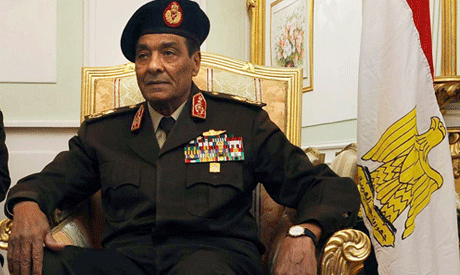
Over the past nine months fanatic elements within the Egyptian Muslim community have stirred up civil unrest all over Egypt. Copts have been attacked, houses and shops looted, and churches burnt down. While it is true that a general degree of anarchy has prevailed in the country since the revolution, one expects that as the new order comes to fruition, such anarchy will quickly be brought under control. THis is to be expected when so drastic a revolution happens in any nation. But acts of violence along religious lines will divide the country and turn it into another Lebanon. As thousands of Egyptian Copts protested the lack of protection from the ruling Army since the revolution, the army opened fire killing dozens of civilians and injuring hundreds. The Army has blamed “unknown culprits” for the violence. Yet surely, there is no doubt as to who did the killing?
If Egypt is ever to become a modern country it has to embrace modern standards of integrity and accountability. Provocateurs are being blamed for inciting the violence, yet we have often seen armies in other countries counter such violence without killing anyone. Why can’t the Egyptian army do the same? Are they not well enough trained? It is simply not good enough to say “they started it”. You are the ones with the training and the weapons!
After this terrible incident any decent army command would very quickly find out who gave the orders to fire on civilians and make a public example of them so that the rest of the soldiers understand that this absolutely unacceptable. The Army showed admirable constraint and what seemed to be great wisdom in refusing to use violence against protesters during the January revolution. Why has that restraint disappeared now? Why does it disappear only against Christians?
If the army does not want to be seen as being selective in who it protects, Read the rest of this entry »
More Things …
Oct 7th

Three interesting new resources I have come across recently, and thought I might share with you today:
In 1991 a huge project came to fruition with the publication of the eight volume Coptic Encyclopedia. Containing nearly three thousand entries by a variety of authors, both members of the Coptic community and foreign scholars in Coptology, it is perhaps the most comprehensive reference on all things Coptic ever produced. The hard cover eight volume set is not only very expensive, but has also been out of print for some years and hard to get a hold of. So it was with great pleasure that I came across this wonderful project at Claremont Graduate University in California. An excerpt from the announcement of this project:
The Coptic Encyclopedia, published by Macmillan in 1991, is an eight-volume work. Its 2,800 entries, written by 215 scholars, took 13 years to compile. But as a paper-bound document it was only available to a limited readership and nearly impossible to amend. The digitized version, renamed the Claremont Coptic Encyclopedia, can be constantly updated and is available to anyone with an Internet connection.
Apparently, Phase 1, which began in 2010, is to digitise and make available all 2,800 articles in the original 1991 edition. You can access the articles far completed here. Last I checked, they were somewhere in the “O” section, working alphabetically from “A”. Phase 2 will be to add multimedia accompaniments to appropriate articles, especially pictures and perhaps audio. Phase 3, and most exciting of all, is to provide continuous updating of existing articles and add new ones to reflect ongoing research and developments in the field of Coptology, and to track the unfolding history of the Coptic Church in the twenty first century. Three cheers for CGU!
How often have you turned up at Church on a feast day or during a fast and wondered why everyone was doing things differently? Read the rest of this entry »
Of All Nations
Jun 29th

One of the nicest things about living in Australia is that you don’t really have to go out and visit the world – the world comes to you. Being a multicultural society, Australians are born or trace their heritage to nearly every country in the world. Our society is enriched by a multitude of languages, accents, and forms of dress, not to mention the delicious cuisines and tastes of scores of cultures.
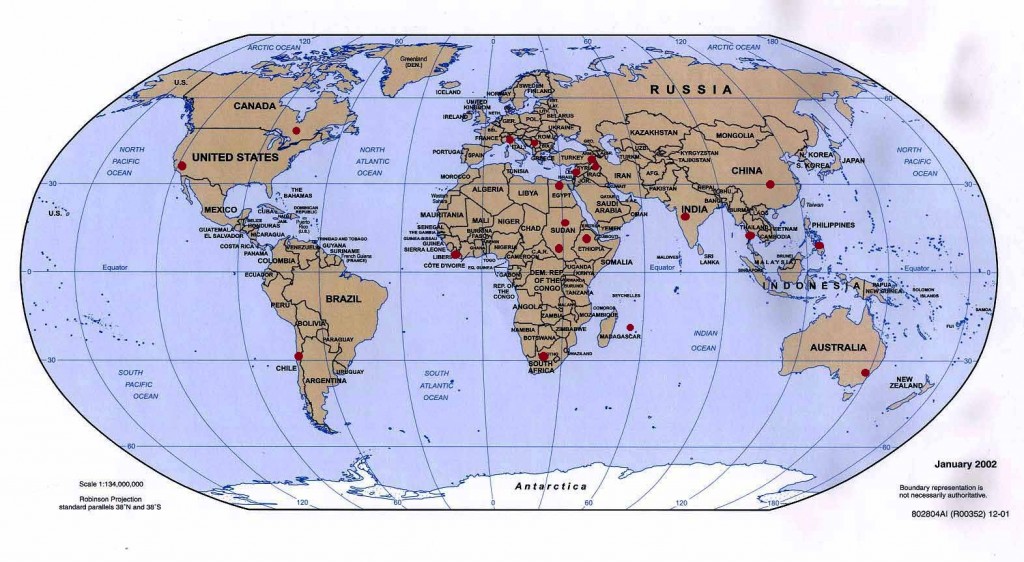
Through marriage and through the blossoming Outreach Service to the neighbours at our parish, we now count as members of our Christian family people from a rich variety of backgrounds. The map shown illustrates the various countries from which members of our parish have come, and they are listed at the end of this post.
The Apostles’ Fast is all about celebrating the incredible work of the Holy Spirit in spreading the Good News of Christ to all the nations. Whereas the Old Testament chosen people tended to be isolated and keep to themselves, the New Testament Christian is commanded to “Go therefore and make disciples of all the nations, baptizing them in the name of the Father and of the Son and of the Holy Spirit” (Matthew 28:19).
That is not to say that this is an easy command to carry out. One of our experiences over the years has been a certain tension between our history and our destiny. On the one hand, there is fourteen centuries of being a relatively insulated faith community that was beaten into submission by hostile Muslim suppression, so much so that we lost the desire or the skill to evangelise others. When we came to Australia, much of this mindset came with us, and we found ourselves being suspicious of ‘outsiders’, mistrusting their motivations and their morals. On the other hand, younger generations of Copts have been imbued with the Australian ethic of respect for others as equals regardless of their race or colour, and a desire to connect and interact with the Australian society of which we are a part. Read the rest of this entry »
Close Encounters of the Theological Kind.
Jun 12th
Sitting at home in bed with a nasty respiratory infection is not my ideal way of spending a Sunday morning. My groggy head makes it hard to focus, and I find my thoughts turning to the heavens above…
A milestone was recently passed: the 555th extrasolar planet was confirmed. An extra solar planet is a planet orbiting a star other than our own sun. When I was growing up, there was a debate going on as to whether such planets even existed. Then in 1992 a few thousand years of wondering came to an end when the first extrasolar planet was discovered, whizzing around a pulsar. Since then, the discoveries have come thick and fast, with new methods for detecting the slippery little creatures being developed all the time. A few of the planets have even posed for a photo, like this one orbiting Fomalhaut (see picture), a star just 25 light years away in the constellation of the Southern Fish (Fomalhaut is Arabic for ‘mouth of the whale’). The Kepler space observatory is expected to take the figure into the thousands.
How exciting! Imagine what it might be like to travel to one of these planets orbiting around an alien sun. What exotic landscapes would we see? What new science might we learn there? For all human existence, we have been limited to one little, tiny corner of the universe. Until a few decades ago, we had no direct physical access to anything except what we could find here on earth. And then, as we began to send robots to the moon, the planets, the asteroids and comets of our own solar system, we were constantly surprised by what we discovered. Our furthest explorers, the Viking probes launched in the 1980s, are only now approaching the edge of our solar system, and again, making unexpected discoveries. What might we discover in an alien solar system?
Could there be life?
The scientific answer to that question is an interesting one. Most scientists who think about it believe the chances are pretty good that life exists somewhere else in the universe, but that our chances of ever coming across it are pretty dismal. Much of this thinking can be traced back to the famous Drake equation that calculates the probability of life and compares it to the number of planets that might be capable of harbouring life. There is ample speculation out there on the scientific and social questions that are raised by the possibility of alien life, so I won’t go into them here. But there is another set of questions that is a little harder to find being discussed.
The theological questions are no less interesting. I recall hearing HG Bishop Moussa commenting on this topic at a conference once: “If we find life on other planets, we’ll just tuck our Bibles under our arms and go and preach to the aliens” he said. A nice repost for an impromptu response, but perhaps there is more to the matter? Read the rest of this entry »
Attachment Styles
Jun 3rd
![IMG_0069[1] IMG_0069[1]](http://www.frantonios.org.au/wp-content/uploads/2011/06/IMG_00691-300x225.jpg)
In the January/February edition of Scientific American Mind there was an interesting article about ‘Attachment Styles’. Apparently getting married and living under the same roof means that things like your heart rate, breathing rate and hormone levels all come to be regulated by your partner. The two ‘form one physiological unit’. That’s what the Church has been saying for centuries: “And the two shall become one flesh”.
The premise of the article is that we all fall into one of three attachment styles; patterns of behaviour in our relationship with our spouse. The compatibility of these styles is a big determinant of how successful and happy a marriage is. Here is an excerpt defining the three styles:
SECURE Attachment Style
I find it relatively easy to get close to others and am comfortable depending on them and having them depend on me. I don’t often worry about being abandoned or about someone getting too close to me.
AVOIDANT Attachment Style
I am somewhat uncomfortable being close to others: I find it difficult to trust them completely and difficult to allow myself to depend on them. I am nervous when anyone gets too close, and often romantic partners want me to be more intimate than I feel comfortable being. Read the rest of this entry »
IVF and Cloning Part 1
Jul 19th
One of the major issues challenging our ethics in the 21st century is the issue of human cloning. There are compelling parallels to the rise of nuclear energy 60 years ago. Whilst nuclear energy has given us a relatively clean source of incredible amounts of energy, and is even used in medicine to save lives, it also brought with it the ability to destroy the world as we know it. Would we have been better off if the power within the atom had never been unleashed?
Cloning today provides a stunningly similar set of ethical questions. Most people are happy with the idea of cloning plants or even animals if it will provide some benefit to humanity, but when it comes to considering cloning a human being, we run into a minefield of questions, for most of which we have yet to find satisfactory answers.
Nor is it a hypothetical question any more. At this very moment, Read the rest of this entry »
O, for an honest politician!
Jun 27th
Angela brings up the topic of Australia’s new Prime Minister, Ms Julia Gillard.
She is right in saying that priests tend to stay out of politics, and so it should be, but I am going to offer a few non-political observations on the political landscape. I have always thought that faith ought to be applicable to every sphere of our lives, without exception. Politics is one area where perhaps we need to apply our faith the most, for it is the sphere where the major decisions that determine the external nature of our lives are made. Living in a democracy, we get to choose who makes those decisions, and thus have a responsibility to make the best choices we can.
Firstly, it is the first time Australia has ever had a woman Prime Minister. Someone actually pointed out to me that we now have a women-only government, starting from the Queen, the Governor General, Prime Minister, Governor of NSW, Premier of NSW and even the Lord Mayoress of Sydney – all of whom are women! In today’s world, the ideal of equal opportunity has, rightly I think, largely emilinated older ideals of the fragility of women. We should get the best person to do the job, regardless of race, colour, creed or gender. There are many who feel at the moment that Julia Gillard is the best person for the job, so let’s see what she can do.
There is no doubt poor old Kevin Rudd, until recently, Prime Minister of Australia, has been dealt with rather harshly. Read the rest of this entry »
Punctuality Punctuated
Jun 24th
It never fails.
The moment you decide to go for it, the instant you steel your will and take up your weapons for battle, something has to happen to make your goal suddenly seem that much harder.
Last time I shared my intention to be more punctual – a brave thing to do. What followed was an illness that meant I had to not only not arrive on time for my next few days of appointments, but cancel them altogether! Talk about not keeping your word. The good news is that I’m back out of hospital now with little permanent damage done, and I’m not going to give up! It may well be some time before I can make appointments again, that’s true, but when I do, I am going to try to be punctual to them.
This kind of thing does not surprise me. It is for me one of the indirect proofs of the existence of God. If God didn’t exist, why should it prove so consistently darned hard to obey Him?
It is also good for the soul. Obstacles give us an opportunity to be stubborn in a good way, and that’s something most of us relish. At least you are sure whose side your on. Give me a clear path with lots of obstacles over a confusing path anytime.
Fr Ant
Punctuality
Jun 16th
Time Stress...
I have a confession to make.
I am not always very punctual.
The more cynical among you may be thinking right now, “Isn’t that compulsory for a Coptic priest? Don’t they teach that during their 40 days of training?”
Of course, the reality is that Egypt lies at the junction of the Middle East and Africa, two regions of the world where puncuality as a priority rates somewhere between eating your greens and polishing your carburettor. If the West enjoys occasionally being ‘fashionably late’, everyone in the Middle East is a trend leader, while the dark continent loves to remind you, “No hurry in Africa”. No wonder that Egyptians, by and large, are not a very punctual people.
But here’s my problem: not only do I serve with a priest who is abnormally punctual, but I am married to one of the most punctual people I know! I am developing an inferiority complex! If they can do it, why can’t I?
Lateness is an attitude. If you are engrossed in the thing you are doing at the moment, it is easy to lose track of time. It is easy for the person you are talking to now to seem more pressing than the person you have not yet reached. Somewhere in the back of mind lurks the idea that nothing so terrible will happen if I’m a little bit late. And of course, the little bit becomes a little bit more, and little bit more, and… oops.
I can see spiritual benefits in this attitude, not to mention health benefits. Surely it is a good thing to give the person you are with your fullest attention? Doesn’t that let them know that they are important to you? It also means that you can do things properly, rather than leaving things half finished. Then of course, there is the valuable humility you gain from constantly apologising to people when you are constantly late. Healthwise, it is really good for you not to stress over the little details of life. Your blood pressure will thank you, even if the person waiting for you will not.
But my wife said something to me once that gave me pause: “Being punctual,” she said, “is keeping your word.” I had never really thought of it like that. If Egyptians are famous for lateness, Upper Egyptians (of which I am one) are proverbial for keeping their word – no matter what. So every time I am late, I am actually breaking my word to someone. “I’ll be there at 7,” I confidently tell them. When I eventually arrive at 7:30, not only have I kept them waiting for me for half an hour, but I have also broken my word. That’s not a nice thing to do. The message it sends is that the person waiting for you is not that important. Perhaps that your time is more valuale than theirs, so it is fine for them to wait for you.
Punctuality is often viewed as a cultural thing. But if so, I wonder why many of our Coptic youth who have been brought up here in Australia still seem to have the lousy punctuality of their parents. I begin to wonder whether there is not more to it than just culture. Maybe there is a personal choice to be made here. Can an unpunctual person really change? Can a Coptic priest really turn up on time? I have known some who do, on a regular basis!
Well, I’m going to give it a try!
I’ll let you know how it goes … some time …
Fr Ant
Who Do You Trust?
May 21st

Trust is never an easy thing to attain...
Among the difficult questions in life is trust. We cannot survive without trust, but then again, we are constantly anxious about who, when and why to trust.
On the simplest of levels, you trust that the glass of water you drank this morning did not contain some deadly germ, and that the brake pedal in your car is actually going to stop the car when you need it to. (I once owned a car where this was not always true, by the way. We developed a very close relationship, that car and I. We came to know each other’s limits intimately; I knew the distance the car required to stop on the flat using only the manual downshifting of gears and the hand brake, while it came to know what I sounded like when I thought I was about smash into a tree.)
But it’s not usually the inanimate objects that give us grief with trust. Far more often, it’s the other humans. I think we are all born with an innate willingness to trust; an innocence if you like. You need only watch a three year old being tossed high into the air by her Daddy, see the huge grin and hear the cackling, to know that here is an example of absolute trust. Daddy drop me? The very thought is impossible!
But by the time we are adults, we find it hard to take people at their word or completely depend on someone. Between innocent childhood and suspicious adulthood something changes. Of course, the change occurs through bitter experience. Once someone lets you down, you find it hard to trust that person again. If it ever happened that a Daddy did actually drop his daughter (surely not!) that daughter would no doubt be quite wary of games with Daddy after that. And so it goes on through our early lives: promises broken, agreements dishonoured, honesty repaid with humiliation, secrets betrayed…
If it only happened once, perhaps we would have a fighting chance of maintaining our innocence. But when it happens many times, we naturally develop an instinct of wariness and caution that eventually comes to colour our personality and our whole approach to life. Shatter trust often enough and the person will withdraw into their own safe little world of lonely isolation where no one can hurt them anymore. How sad.
Life a lot nicer when you can trust. To live in constant doubt about others is to live without peace. If we are ever to share a sincere relationship with someone, we have to let them in to our inner thoughts and emotions, share with them the experiences that made us who we are. But to do so is to leave oneself incredibly vulnerable to the other. he might go and tell someone else, or criticise me, or not like me, or worse of all, laugh at me! It is so hard to trust another person with your real self, and yet, if we don’t, we are doomed to a sad life of loneliness.
As a parent, you learn how important trust is in the relationship with your child. You cannot be with them twenty four hours a day, so they have to learn how to keep safe, how to be sensible in their choices, how to resist temptation and how to be honourable and remain steadfastly true to their principles. That trust is not easy to achieve. It involves a lot of heartache, not knowing how things are going to turn out, sometimes even running the risk that the child may be hurt in some way, but it’s the only way to develop true trust.
And the trust has to work both ways. A child can only learn to be trustworthy if they have a living example of trustworthiness before them every day. The parent who takes the shortcut of telling a little fib to escape to buying those chocolates at the checkout today will find their child telling them fibs about anything and everything tomorrow. There are no shortcuts to trust, no discounted sales: it’s expensive, and part of the price is being utterly trustworthy yourself.
God trusts us.
He shows us His trust in the incredible degree of freedom He gives us. Yes, if I choose foolishly to eat unhealthily or to blow myself and others up as a suicide bomber, he doesn’t forcefully stop me. God grants every one of us genuine freedom of action, even knowing the consequences of a bad choice. Why does He do that? Why doesn’t He make the world such that no one can hurt anyone else? Perhaps He could enclose every human being in a sort of force field that is impervious to evil actions! Every time you tried to hurt someone, you couldn’t pierce the shield around you. Wouldn’t that be a much nicer world to live in?
Or would it? I know many parents who would love to get their hands on an invention like that, and would love even more to get their children shackled inside one! But then, where is the freedom? Where is the chance to learn real lessons? Where is the trust? No, God does not deal with us like that. Instead He chooses to unleash us on the world and leave us to make our own choices, choices with real consequences not just for us, but for others also. Only in this way can we become the kind of creatures He wants us to be, or develop the kind of relationship He wants with us.
Can you trust God?
As life goes on, everyone goes through experiences that shake their trust in God, and in some cases, destroy it completely. “How could God have let such a thing happen?” is not an uncommon question. How can we trust God when things go so wrong in this world? How do we know He’s not going to drop us?
Bu there’s the beauty of it. He never does! Oh sure, there are times when it really feels like He has. We see the ground screaming crazily towards us and we get that sick feeling in the pit of the stomach that this time, everything is not going to be alright. But then, it is. Maybe not when we want it to be, maybe not how we want it to be, but wait long enough and sure enough, there it is: the safe hands that reach out at the very last moment when all seems lost and gently hold us and draw us back into that powerful safe embrace.
Those who have been up and down often enough learn to trust those powerful hands. They know that it simply cannot happen that He should ever drop one of His children.
“Can a woman forget her nursing child, and not have compassion on the son of her womb?
Surely they may forget, yet I will not forget you.”
Isaiah 49:15.
Now that’s a promise worth trusting.
Fr Ant


Recent Comments
hey ppl like it on facebook share it with your friends make it go viral
One of the 14 Anaphoras used in the Ethiopian Orthodox Tewahedo Church is the Anaphora of Our Lord. I think it perfectly and beautifully...
I refused to watch this video on YouTube so as to not add to the “views” and subsequently the fame of an ignorant man. So...
Hi Father Antonios just wanted to say that I have benefited from this article and I also found the seatbelt joke funny anyways...
Dear father and all, enclosed a video in response to the above video , interesting views going around by millions...